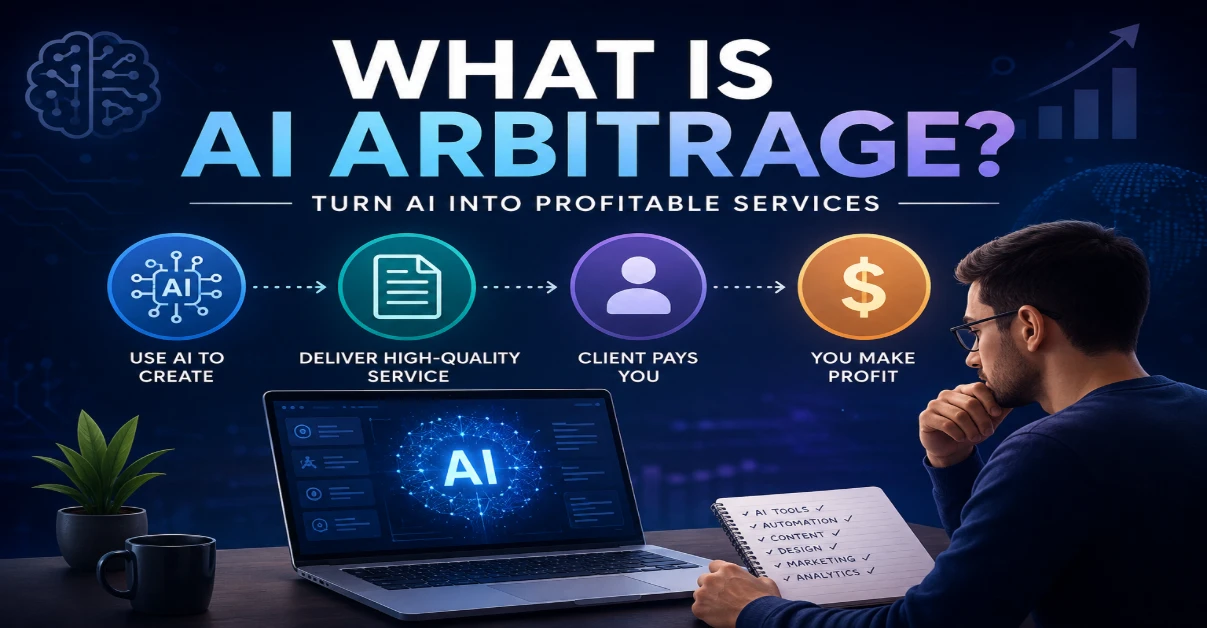
AI arbitrage is the practice of using AI tools to reduce the time and cost of delivering a service while selling the finished result at a higher market value. Instead of simply reselling AI-generated output, an AI arbitrage business combines automation with human expertise, quality control, and industry knowledge to create a useful product or service.
The idea is not completely new. Businesses have always looked for ways to improve productivity by using better software, outsourcing work, or automating repetitive processes. AI has simply made this strategy much more accessible. Today, a freelancer, agency, or small business can use AI writing tools, image generators, automation platforms, coding assistants, research tools, and customer-support systems to provide services that once required larger teams.
However, successful AI arbitrage is not about pressing a button and selling whatever an AI tool produces. The real opportunity comes from combining AI with human judgment, quality control, creativity, industry knowledge, and customer service.
What Is AI Arbitrage in Simple Terms?
AI arbitrage is a simple business model where you use AI tools to complete work faster and more cheaply, then sell the finished service to clients at a higher price.
For example, imagine a small business needs 20 social media posts. Instead of spending several hours creating everything manually, an AI arbitrage freelancer might use AI writing and design tools to produce the initial content, then edit, fact-check, customize, and package it professionally. If the client pays $300 for the service and the tools and other costs total $50, the remaining amount is the potential gross margin.
The key idea is not simply reselling AI-generated content. Successful AI arbitrage usually involves adding human judgment, quality control, strategy, editing, and client-specific customization.
Simple Formula
Client payment − AI tools and operating costs = potential profit
Common AI arbitrage services include:
- AI-assisted content writing
- Social media content creation
- AI video editing
- Graphic design
- SEO content and optimization
- Email marketing
- Lead generation
- Chatbot setup
- Data research and analysis
- AI automation services
How Does AI Arbitrage Work?
AI arbitrage generally involves several stages. The exact process depends on the service, but the underlying model remains similar.
1. Find a Service People Already Need
The first step is identifying a service with existing demand.
Examples include:
- Blog content
- Social media content
- Product descriptions
- Video editing
- Graphic design
- Presentation creation
- SEO research
- Email marketing
- Customer support
- Data processing
- Software development
- Lead generation
- Market research
The goal should not simply be to find something AI can do. You need to find something customers are willing to pay for.
2. Choose the Right AI Tools
Once you identify the service, select AI tools that can reduce production time or improve the workflow.
For example, a content business might use AI for research assistance, outlining, drafting, editing, and content organization. A video service could use AI for transcription, captions, noise reduction, scene detection, or initial editing.
The best tool depends on the specific task.
Using ten AI tools does not automatically create a better business. Sometimes a simple workflow using two or three reliable tools is more efficient.
3. Add Human Expertise
This is where many AI arbitrage businesses can differentiate themselves.
Raw AI output may contain incorrect information, generic wording, awkward phrasing, or unnecessary repetition. Human review helps identify these problems.
A human operator can:
- Check facts
- Improve accuracy
- Match brand voice
- Add original insights
- Remove generic language
- Verify important claims
- Improve formatting
- Understand customer requirements
- Make the final product more useful
The human contribution is often what turns an AI-generated draft into a professional deliverable.
4. Deliver a Valuable Result
Customers generally care about outcomes rather than the technology behind them.
A company hiring someone for SEO content wants useful pages that support its marketing goals. A business ordering social media content wants posts that fit its audience and brand. A company requesting a chatbot wants a system that helps customers.
Therefore, AI should be treated as a production advantage rather than the entire product.
AI Arbitrage vs. Traditional Outsourcing
AI arbitrage is sometimes compared with outsourcing because both approaches can reduce production costs.
Traditional outsourcing usually involves hiring another person or company to perform a task. AI arbitrage adds automation or AI-assisted workflows to the process.
For example, a traditional agency might have five people producing content. An AI-assisted agency could potentially handle some parts of the workflow with fewer people while using AI to accelerate repetitive tasks.
This can reduce production time and allow a small team to handle more projects.
However, outsourcing and AI arbitrage are not mutually exclusive. A business can use both.
For example:
AI tool → freelancer → editor → final client delivery
In this model, AI handles repetitive work while human workers provide expertise and quality control.
Why Is AI Arbitrage Becoming Popular?
Several factors are contributing to the growth of AI-assisted business models.
Lower Production Costs
AI tools can automate certain repetitive tasks, potentially reducing the amount of manual work required for each project.
Lower operating costs can create better margins when the service is priced according to its value.
Faster Delivery
Tasks that previously took several hours may sometimes be completed much faster with AI assistance.
For service businesses, faster production can mean more capacity without increasing the team size at the same rate.
Easier Entry for Small Businesses
Starting a traditional agency can require employees, office space, expensive software, and significant operational costs.
AI tools can reduce some of these barriers, allowing individuals and small teams to experiment with service businesses using relatively limited resources.
Growing Demand for AI-Assisted Services
Businesses are increasingly exploring AI for marketing, customer service, research, software development, content creation, and automation.
This creates opportunities for people who understand both AI tools and specific business problems.
Popular AI Arbitrage Business Ideas
There are many ways to apply the AI arbitrage model.
AI Content Services
You can offer blog writing, product descriptions, newsletters, social media posts, and other content services.
The important part is to avoid delivering unedited AI-generated material. Research, fact-checking, editing, and customization can significantly improve the final result.
AI Video Editing
AI-powered video tools can assist with transcription, subtitles, clips, audio cleanup, and other editing tasks.
A service provider can combine these capabilities with professional editing and storytelling.
This can be particularly useful for creators, businesses, podcasts, and marketing teams.
AI Graphic Design
AI image-generation and design tools can help produce concepts, illustrations, marketing graphics, and visual assets.
Professional services can add value through brand consistency, design principles, revisions, and correct formatting for different platforms.
AI SEO Services
AI can assist with keyword research, content briefs, topic clustering, competitor analysis, and content optimization.
An SEO professional can use these tools to speed up research while applying human judgment to strategy and implementation.
AI Automation Services
Businesses often have repetitive workflows involving emails, spreadsheets, forms, customer inquiries, and internal processes.
An AI automation specialist can identify repetitive tasks and build workflows that reduce manual effort.
This area can be particularly valuable because the customer is paying for improved efficiency rather than simply AI-generated content.
AI Customer Support
AI-powered systems can help businesses handle common customer questions.
A service provider can help configure knowledge bases, automated responses, escalation processes, and human handoff systems.
The quality of the underlying information and workflow is critical because inaccurate automated answers can damage customer trust.
How to Start an AI Arbitrage Business
Starting does not necessarily require a large investment. A practical approach is to begin with one service rather than trying to sell everything AI can do.
Step 1: Choose a Specific Niche
Instead of marketing yourself as an “AI expert,” consider targeting a specific customer group.
For example:
- AI content for SaaS companies
- AI social media services for restaurants
- AI video editing for YouTubers
- AI automation for small businesses
- AI SEO services for ecommerce stores
A focused offer is usually easier to explain and market.
Step 2: Learn the Customer’s Problem
Before choosing tools, understand what the customer actually needs.
Ask questions such as:
- What task takes the most time?
- What process is repetitive?
- What causes delays?
- What work is expensive?
- What quality problems occur?
- What result does the customer want?
This prevents you from building a business around technology that does not solve a meaningful problem.
Step 3: Build a Repeatable Workflow
Create a process that can be repeated for every client.
For example:
Client brief → Research → AI-assisted production → Human review → Quality check → Delivery
A repeatable workflow makes it easier to maintain quality as your workload increases.
Step 4: Create Samples
Potential customers want evidence that you can produce good work.
Create several examples that demonstrate your service. If you are offering AI-assisted content, prepare sample articles. If you are offering video editing, create before-and-after examples.
Your samples should demonstrate the result, not simply the AI tool you used.
Step 5: Price Based on Value
One common mistake is pricing purely according to the amount of time saved by AI.
If AI allows you to complete a task in one hour instead of five, that does not necessarily mean the service should become five times cheaper.
Customers are paying for the outcome, reliability, expertise, communication, and convenience.
Your pricing should reflect the overall value of the service while remaining competitive in your market.
What Are the Risks of AI Arbitrage?
AI arbitrage can create opportunities, but it is not a guaranteed way to make money.
Quality Problems
AI-generated content can contain errors or lack originality. Without proper review, these problems can reach customers.
Increasing Competition
As AI tools become easier to access, more people can offer similar services. Simply having access to AI is therefore unlikely to remain a strong competitive advantage.
Tool Dependency
AI tools can change their pricing, features, limits, or policies. Building your entire business around one platform can create unnecessary risk.
Privacy and Confidentiality
Businesses may provide sensitive information when requesting AI-assisted services. Service providers should understand the privacy and data-handling policies of the tools they use and avoid exposing confidential information unnecessarily.
Customer Expectations
Some clients may assume AI means instant and inexpensive work.
This can create pricing pressure. Strong positioning is therefore important. Instead of selling “AI-generated work,” focus on the business result you provide.
Is AI Arbitrage Ethical?
AI arbitrage itself is not inherently unethical. The ethical question depends on how the technology is used and represented.
For example, using AI to speed up research, generate initial ideas, automate repetitive tasks, or assist with editing can be perfectly reasonable when the final work meets the client’s requirements.
Problems arise when someone:
- Delivers low-quality AI output without review
- Makes false claims about expertise
- Uses confidential information irresponsibly
- Publishes inaccurate information
- Misrepresents AI-generated work where disclosure is required
- Charges for professional work without actually providing the promised value
A sustainable AI business should focus on transparency, accuracy, and customer outcomes.
How to Make AI Arbitrage More Profitable
The biggest opportunity is not simply using more AI. It is building a better system around AI.
Specialize
A specialist can often provide more useful solutions than a generalist because they understand a particular industry’s problems.
Create Standard Operating Procedures
Document your workflow so repetitive tasks can be completed consistently.
Automate Repetitive Tasks
Look for steps that do not require constant human decision-making. These may include formatting, basic data processing, notifications, scheduling, or document organization.
Keep Humans in the Loop
Use human review for tasks involving accuracy, brand reputation, strategic decisions, or customer-facing communication.
Build Long-Term Client Relationships
One-time projects can generate revenue, but recurring services can create more predictable business income.
For example, instead of selling one batch of social media posts, you could offer ongoing monthly content management.
What Is the Future of AI Arbitrage?
The future of AI arbitrage is likely to move beyond simply using AI to produce content cheaply. As AI tools become more capable and widely available, the real advantage will increasingly come from how well people combine AI with human expertise, business processes, and automation.
This means the strongest AI arbitrage businesses may not look like simple AI content farms. They may operate more like specialized service companies that happen to use AI extensively behind the scenes.
For example, an AI-powered marketing agency might use AI for research and production but differentiate itself through strategy, industry knowledge, creative direction, analytics, and client relationships.
That is a much stronger long-term position than simply selling AI-generated output.
Final Thoughts
So, what is AI arbitrage? It is essentially a business approach that uses AI to improve the economics of delivering a service. By reducing repetitive work, increasing productivity, and speeding up production, AI can help individuals and businesses deliver valuable services more efficiently.
But the real opportunity is not simply finding an AI tool and reselling its output.
Successful AI arbitrage depends on identifying a genuine customer problem, building an efficient workflow, maintaining quality, adding human expertise, and delivering a result that customers consider valuable.
AI can make production faster and cheaper, but value still comes from solving problems well. Anyone considering an AI arbitrage business should therefore focus less on chasing the newest tool and more on building a reliable service around a specific customer need.
When technology and human expertise work together, AI arbitrage can become more than a short-term trend—it can be a practical model for building modern, efficient service businesses.
Frequently Asked Questions About AI Arbitrage
AI arbitrage is a business model where you use artificial intelligence tools to complete services more efficiently, then sell those services to clients at a higher price. The difference between your revenue and costs can become your profit.
AI arbitrage typically involves finding a service that clients need, using AI to reduce the time or cost required to deliver it, adding human review and expertise, and charging the client for the completed service.
Yes, AI arbitrage can be profitable when you choose a service with real demand, control your operating costs, and provide results that clients consider valuable. Profitability depends on pricing, competition, tool costs, and the quality of your service.
Common examples include AI-assisted content writing, SEO services, social media management, graphic design, video editing, lead generation, chatbot development, research, and business automation.
Not necessarily. Many AI arbitrage services can be started with basic knowledge of AI tools, marketing, writing, design, or another practical skill. More technical services, such as AI automation and custom integrations, require greater expertise.
No. AI arbitrage usually involves using AI tools to deliver a service or business outcome. You are selling the finished service and its value, rather than simply reselling access to an AI platform.
Yes. Beginners can start by choosing one simple service, learning the relevant AI tools, creating a few examples of their work, and approaching potential clients. Starting with a narrow service is often easier than offering everything at once.
The future of AI arbitrage is likely to focus more on specialized services, AI automation, and industry-specific solutions. As AI becomes more accessible, human expertise, quality control, strategy, and the ability to deliver measurable results will become increasingly important.